
Generative Engine Optimization (GEO) is the practice of shaping your website and your wider online presence so that AI assistants such as ChatGPT, Gemini, Perplexity and Google’s AI Overviews mention, cite and recommend your business in their answers. SEO tries to rank a page in a list of links. GEO tries to get your business named inside the answer itself.
Why does GEO matter now?
People increasingly ask an AI assistant instead of scrolling through search results. In January 2026, Business Today reported on an OpenAI study finding that around 40 million people worldwide use ChatGPT for health and medical questions. Among survey respondents, over 55% used it to ask about symptoms, 48% to understand medical terms and 44% to explore treatment options.
When someone asks “Who is a good paediatrician near Baner?” or “Which agency in Pune does SEO for hospitals?”, the assistant usually names a handful of options and moves on. If you are not one of them, you are not shortlisted, however well your website ranks for a keyword.
How is GEO different from SEO?
GEO is built on top of SEO, not instead of it. AI assistants that search the web still need to find, crawl and trust your pages. What changes is the goal and what gets rewarded.
| Traditional SEO | GEO | |
|---|---|---|
| Goal | Rank a page on Google’s results | Be named or cited inside an AI answer |
| Unit of success | A click to your page | A mention, recommendation or citation |
| What gets rewarded | Relevance, links, page experience | Clear, quotable facts, credible sources, consistent entity information |
| Where it happens | Google and Bing results pages | ChatGPT, Gemini, Perplexity, Claude, Google AI Overviews |
| How you measure it | Rankings, traffic, conversions | Asking the AI tools your customers’ questions and logging who gets cited |
What does the research say works?
The term comes from a 2023 research paper, GEO: Generative Engine Optimization, by Pranjal Aggarwal and colleagues (published on arXiv in November 2023 and presented at the KDD 2024 conference). The authors tested how changes to a web page affect its visibility in AI-generated answers. They found that the right changes can boost visibility by up to 40%.
The methods that helped most were simple editorial ones:
- Citing sources: linking to credible references for your claims.
- Adding statistics: replacing vague claims with specific numbers.
- Adding quotations: including relevant quotes from credible people or bodies.
The authors also found that results vary by subject area, and that old-style keyword stuffing did not help. In short, AI engines reward content that is easy to verify and easy to quote.
How do you optimise for AI search? A five-layer checklist
We work through five layers with every client. Each one builds on the one before.
- Make your content extractable. Open each section with a direct one-to-three-sentence answer. Phrase headings as the questions people actually ask. Use tables for comparisons and numbered lists for steps. Define terms where you first use them.
- Make it worth citing. Put a real name and credentials on your content. Show publication and “last updated” dates. Back claims with sources and specific numbers. Publish original data if you have it, because AI tools prefer primary sources.
- Add structured data. Use schema.org markup (JSON-LD) to describe your business, services, people, FAQs and articles in machine-readable form, and fill in the recommended properties as well as the required ones.
- Let AI crawlers in. Check that your robots.txt and your hosting firewall do not block crawlers such as GPTBot, OAI-SearchBot, ClaudeBot and PerplexityBot. Keep important content in the HTML rather than loading it only with JavaScript. Consider an
llms.txtfile that summarises your site for language models. - Strengthen your entity signals. AI tools cross-check facts across the web. Keep your name, address and phone number identical everywhere: website, Google Business Profile, directories and social profiles. Earn mentions in credible third-party lists, articles and reviews.
A common hidden problem: many hosting providers have bot protection that quietly blocks AI crawlers. Your robots.txt can say “allow” while the server still answers “429 Too Many Requests”. Test your site with each crawler’s user agent, not just your browser.
How do you know if GEO is working?
There is no “ranking position” for AI answers, so measure it directly:
- List the 10 to 20 questions your ideal customers would ask an AI assistant.
- Ask each question in ChatGPT (with search), Gemini, Perplexity and Google, and note which businesses and sources each one names.
- Repeat every quarter and compare. AI products change quickly, so a single snapshot means little.
Alongside that, watch your analytics for referral traffic from chatgpt.com, perplexity.ai and gemini.google.com, and ask new enquiries how they found you.
Does GEO work differently for healthcare?
Yes, in two ways. First, AI systems are more cautious with medical topics, so trust signals carry more weight: qualified authors, registration details, accurate and sourced claims, and a consistent clinic identity across Google, directories and your website. Second, healthcare marketing in India has ethical limits on self-promotion. Good GEO for doctors focuses on clear, accurate patient information rather than claims about being “the best”. We cover those limits in our guide to NMC advertising rules.
Key takeaways
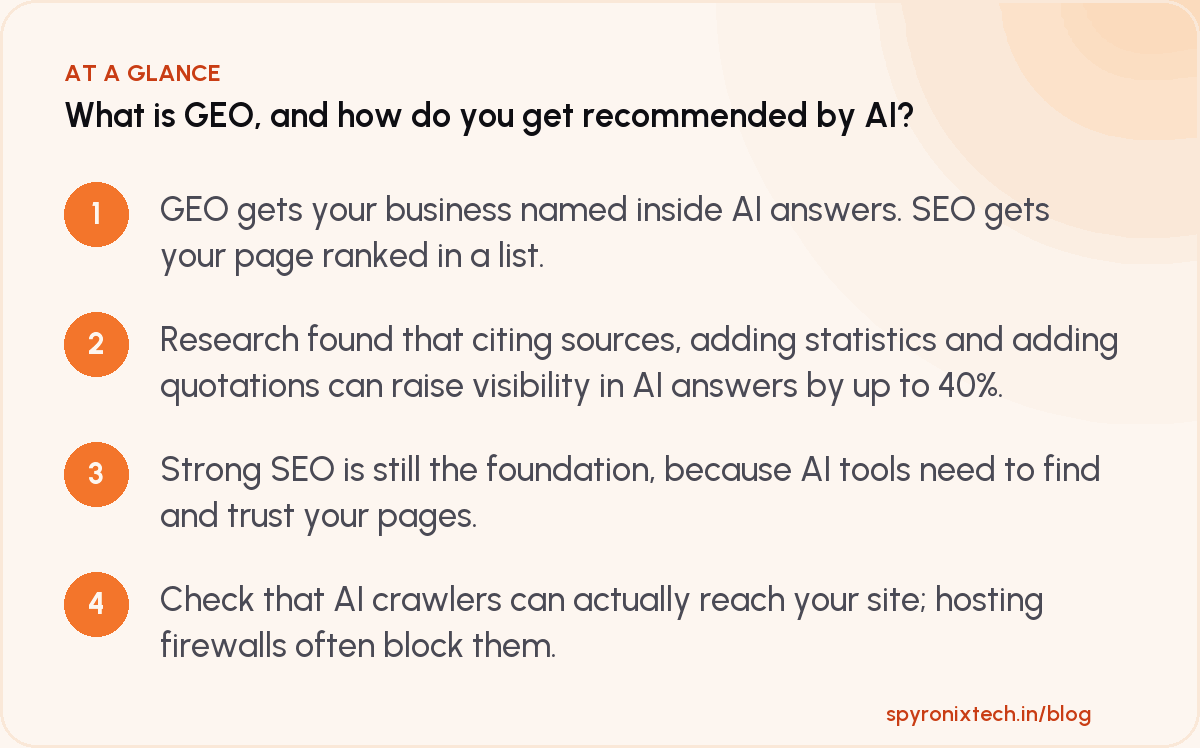
- GEO gets your business named inside AI answers. SEO gets your page ranked in a list.
- Research found that citing sources, adding statistics and adding quotations can raise visibility in AI answers by up to 40%.
- Strong SEO is still the foundation, because AI tools need to find and trust your pages.
- Check that AI crawlers can actually reach your site; hosting firewalls often block them.
- Measure by asking the AI tools your customers’ questions, every quarter.
Frequently asked questions
Is GEO the same as AEO?
They overlap heavily. Answer Engine Optimization (AEO) usually refers to winning direct answers, such as featured snippets and voice answers. GEO refers specifically to generative AI tools that write their own answers. In practice the same work serves both.
Does GEO replace SEO?
No. AI assistants that browse the web rely on search indexes and on the same signals of quality and trust. A site with weak SEO rarely does well in AI answers.
How long does GEO take to show results?
Technical fixes, such as unblocking crawlers and adding structured data, can be picked up within weeks. Building enough credibility to be recommended for competitive questions usually takes several months of consistent content and reputation work.
Was this guide useful?
Let us know with a reaction. It's anonymous.
Share it with someone who needs it
Sources
- GEO: Generative Engine Optimization, Aggarwal et al., arXiv (2023), KDD 2024
- 1 in 4 ChatGPT users rely on AI for healthcare support weekly, Business Today (7 Jan 2026)
Written by Team Spyronix, Pune. Last reviewed .