
Doctors in India are not allowed to solicit patients or advertise their own skills, qualifications or achievements, under the Indian Medical Council (Professional Conduct, Etiquette and Ethics) Regulations, 2002. These 2002 rules currently apply because the National Medical Commission (NMC) put its newer 2023 conduct regulations on hold. Doctors can still share factual information and patient education. Hospitals and nursing homes have slightly more room to advertise.
Not legal advice. This article summarises published regulations for general information. Rules and their interpretation change. Check the latest position on nmc.org.in and with your State Medical Council or a lawyer before running any campaign.
Which rules apply right now?
In August 2023, the NMC notified the Registered Medical Practitioner (Professional Conduct) Regulations, 2023. Following objections, including from the Indian Medical Association, the NMC issued a notification on 23 August 2023 keeping those regulations in abeyance. They are not operative until a further gazette notification, and the 2002 Regulations were directed to apply in the meantime.
Some industry blogs report that the NMC has issued newer guidance on ethical advertising in 2026. At the time of writing, we could not confirm this on the NMC’s official website, so this article relies on the 2002 Regulations. If new rules are notified, they take precedence.
What can doctors not do?
Regulation 6.1 of the 2002 Regulations deals with advertising. In summary, it treats the following as unethical:
- Soliciting patients, directly or indirectly. This applies to individual doctors, groups of doctors and institutions.
- Advertising or publicity that draws attention to a doctor’s skill, qualifications, achievements or attainments, or that aims at self-promotion.
- Endorsing drugs or products using the doctor’s name, signature or photograph.
- Boasting about cases, cures or operations.
- Photographs or similar publicity on letterheads and signboards (Regulation 6.1.2). Anatomical sketches and diagrams are not treated as unethical.
- Oversized signboards, or signboards showing anything beyond the doctor’s name, recognised qualifications, specialty titles and registration details (Regulation 7.13).
State Medical Councils do act on this. Published Delhi Medical Council orders, for example, cite Regulation 6.1.1 in cases involving newspaper advertisements by clinics.
What are doctors allowed to do?
The 2002 Regulations permit formal announcements in the press for these purposes:
- starting a practice;
- a change in the type of practice;
- a change of address;
- temporary absence from duty;
- resuming another practice;
- succeeding to another practice;
- a public declaration of charges.
Institutions such as nursing homes and private hospitals run by doctors may advertise in the lay press under Regulation 7.12. The advertisement should be limited to the institution’s name, the type of patients admitted, the training and other facilities offered, and the fees.
How do these rules apply to websites and social media?
The 2002 Regulations were written before social media, so applying them online is a matter of interpretation. The underlying principles are clear: inform, don’t solicit; educate, don’t boast. The table below shows how many healthcare marketers apply them in practice. It is a cautious reading, not a legal ruling.
| Generally lower risk | Higher risk |
|---|---|
| Clinic name, address, timings, fees and contact details | “Best surgeon in Pune” or other superlatives |
| Recognised qualifications and registration number | Before-and-after photos and “success stories” |
| Patient education about conditions and prevention | Guaranteed outcomes or “100% success rate” |
| Health-awareness posts and videos | Paid ads promoting the doctor’s personal skill |
| Factual descriptions of services and facilities | Patient testimonials praising cures |
| Announcements of new timings or a new location | Discounts, offers or “free consultation” campaigns aimed at drawing patients |
Which other laws apply to healthcare advertising?
- The Drugs and Magic Remedies (Objectionable Advertisements) Act, 1954 prohibits advertisements claiming to treat or cure certain listed diseases and conditions.
- The Consumer Protection Act, 2019 allows action against misleading advertisements, which can include exaggerated healthcare claims.
- Platform policies: Google and Meta have their own restrictions on healthcare and medical advertising, which apply on top of Indian law.
How can doctors grow ethically online?
The rules push doctors towards exactly the kind of content that search engines and AI assistants reward: clear, accurate, well-sourced information. A practical, compliant approach:
- Keep your Google Business Profile complete and factual.
- Publish patient-education pages that answer real questions, written or reviewed by the doctor, with sources and dates.
- Keep your clinic details identical across your website, Google and directories.
- Let genuine patient reviews accumulate naturally, without incentives.
- Make sure your site is readable by AI assistants. Our GEO guide explains how.
Key takeaways
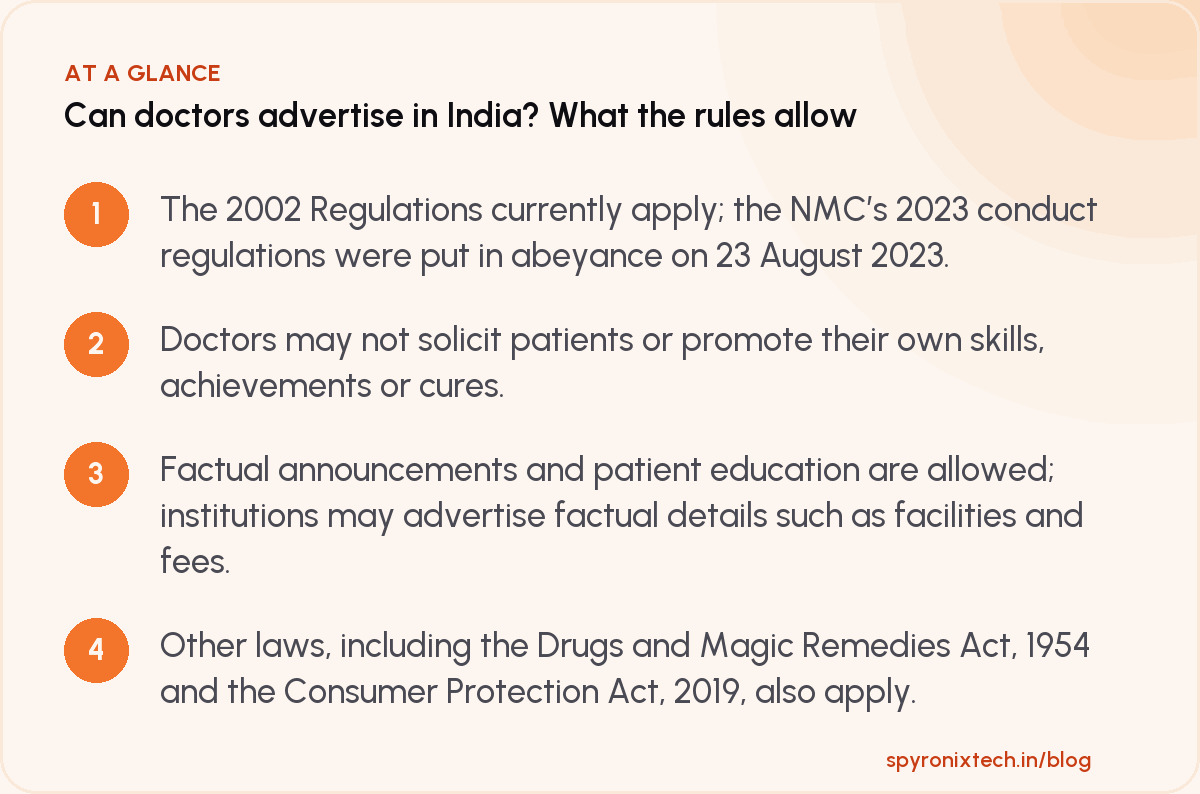
- The 2002 Regulations currently apply; the NMC’s 2023 conduct regulations were put in abeyance on 23 August 2023.
- Doctors may not solicit patients or promote their own skills, achievements or cures.
- Factual announcements and patient education are allowed; institutions may advertise factual details such as facilities and fees.
- Other laws, including the Drugs and Magic Remedies Act, 1954 and the Consumer Protection Act, 2019, also apply.
- Check nmc.org.in and your State Medical Council before any campaign, because the rules may change.
Frequently asked questions
Can a doctor have a website in India?
A factual website with the doctor’s name, qualifications, registration, services, timings, fees and patient education is widely used and consistent with the principle of informing rather than soliciting. Avoid self-promotional claims, testimonials about cures and superlatives.
Can a hospital run Google or Facebook ads?
Regulation 7.12 permits institutions to advertise factual information in the lay press. Online ads must also comply with Google’s or Meta’s healthcare policies and with consumer protection law. Keep ads factual and avoid outcome claims.
Can doctors post on Instagram?
Health-awareness and educational content is generally lower risk. Posts that boast about cases, show “success stories” or promote the doctor’s skill are higher risk under Regulation 6.1.
Was this guide useful?
Let us know with a reaction. It's anonymous.
Share it with someone who needs it
Sources
- The Indian Medical Council (Professional Conduct, Etiquette and Ethics) Regulations, 2002, Indian Journal of Medical Ethics
- NMC puts its Registered Medical Practitioner (Professional Conduct) Regulations, 2023 on hold, Medical Dialogues
- NMC Regulations, 2023 not to be operative till further notification, Complinity
- National Medical Commission (official website)
Written by Team Spyronix, Pune. Last reviewed .