
A website’s cost depends mainly on four things: how many unique page designs it needs, what it has to do (forms, bookings, payments, logins), how much content has to be written, and who builds it and where they are based. A simple brochure site and a custom e-commerce platform can differ in cost by a factor of fifty or more, so any “average price” you see online is close to meaningless without a scope. This guide explains what actually drives the price, so you can compare quotes properly.
What decides the cost of a website?
| Cost driver | Lower cost | Higher cost |
|---|---|---|
| Design | A customised template | Fully bespoke design, illustrations, motion |
| Number of page types | 5 to 10 pages sharing 2 or 3 layouts | Dozens of unique layouts |
| Functionality | Contact form, map, WhatsApp button | Bookings, payments, member logins, dashboards, integrations |
| E-commerce | A few products on Shopify or WooCommerce | Thousands of products, multiple currencies, ERP sync |
| Content | You supply text and photos | Copywriting, photography, video, translation |
| Languages | One language | Bilingual, especially with right-to-left Arabic |
| SEO and performance | Basic on-page setup | Technical SEO, schema, speed optimisation, AI-search readiness |
| Compliance | Simple privacy policy | Consent management, accessibility audits, data-protection reviews |
What type of website do you actually need?
- Brochure or company website: who you are, services, proof and contact. Most small businesses, clinics, consultants and agencies start here.
- Lead-generation website: a brochure site plus landing pages, strong calls to action, tracking and CRM integration. Built to turn visitors into enquiries.
- E-commerce store: product catalogue, cart, payment gateway, shipping and tax rules.
- Web application or portal: logins, dashboards, bookings or custom workflows. Priced more like software than like a website.
Be honest about which one you need today. Many businesses overspend on features they never use, then underspend on the content and SEO that bring customers in.
Does it matter which country your developer is in?
Yes, mostly because of labour costs. Agencies in the USA, UK and the Gulf typically charge much higher day rates than agencies in India for comparable work. That is why many businesses in the USA, UK, UAE and Saudi Arabia hire Indian teams for design and development, while keeping strategy or project management close to home.
The quality range inside every country is wide, though. Judge a team by its portfolio, process, communication and references, not its postcode. Our guide to hiring an Indian web development company covers how to do that safely.
What costs do people forget to budget for?
- Domain name, renewed every year.
- Hosting, from shared hosting for small sites to cloud hosting for high-traffic stores.
- Premium plugins, themes or apps, often charged yearly.
- Payment gateway fees, usually a percentage of each transaction.
- Maintenance: updates, security patches, backups and small changes.
- Content updates and SEO, which keep the site bringing in traffic after launch.
How do you compare website quotes fairly?
- Write a one-page brief: goals, audience, pages, must-have features, examples you like and your deadline.
- Send the same brief to every agency, so the quotes are comparable.
- Ask for a line-item breakdown: design, development, content, SEO, testing and launch.
- Check what is excluded: content writing, stock images, plugins, hosting and post-launch support are common gaps.
- Confirm ownership: you should own the domain, hosting account, code and content.
- Ask how many revision rounds are included, and the cost of extra ones.
Cheapest is rarely cheapest. A site without SEO foundations, fast loading or a clear way to contact you can cost far more in lost leads than you saved on the build. Compare quotes on outcomes, not just price.
Key takeaways
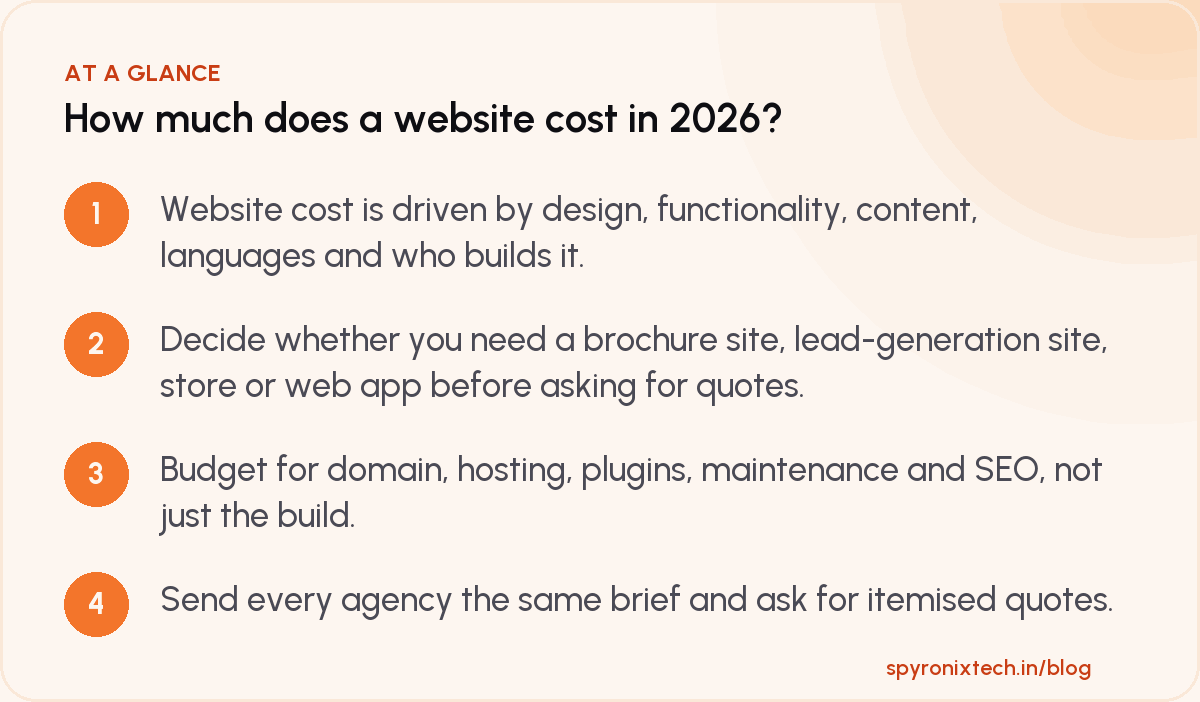
- Website cost is driven by design, functionality, content, languages and who builds it.
- Decide whether you need a brochure site, lead-generation site, store or web app before asking for quotes.
- Budget for domain, hosting, plugins, maintenance and SEO, not just the build.
- Send every agency the same brief and ask for itemised quotes.
Frequently asked questions
How long does it take to build a website?
A small brochure site often takes a few weeks once content is ready. Larger e-commerce sites and web applications can take several months. Delays most often come from waiting on content and feedback.
Is a template website bad for SEO?
No. A well-built template site can rank well. What matters is speed, clean structure, good content and correct technical setup.
Should I pay monthly or one-off?
Both models work. One-off builds give you ownership up front; monthly plans spread the cost and often include hosting and maintenance. Either way, make sure you own the domain and content.
Was this guide useful?
Let us know with a reaction. It's anonymous.
Share it with someone who needs it
Sources
Written by Team Spyronix, Pune. Last reviewed .